

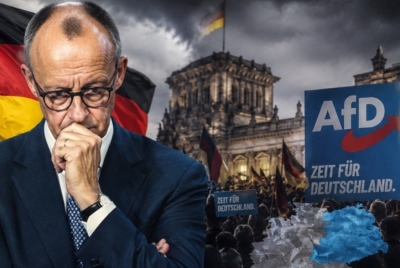
The states of Saxony-Anhalt and Mecklenburg-Western Pomerania are developing into a political laboratory of a much deeper shift: the challenging of the governance model that has dominated Germany since reunification and, above all, the strategy of the so-called «cordon sanitaire» against the patriotic party Alternative for Germany (AfD).
The first critical vote will take place in Saxony-Anhalt on September 6, 2026.
The date is officially set, while recent polls place the AfD between 41% and 43%, with the CDU trailing far behind at approximately 22%-24%.
This margin could enable the AfD to secure even an absolute parliamentary majority and form a state government on its own.
This is not mathematically guaranteed solely by a 42%-43% figure, as it also depends on which smaller parties clear the electoral threshold.
However, the prospect is no longer theoretical, precisely because several smaller forces are hovering near or below 5%.

Historic development - The cordon sanitaire against AfD fractures
Such an outcome would carry historical significance.
The «Brandmauer», the political firewall that traditional German forces have maintained to avoid cooperating with the AfD, would effectively break.
For the first time, the party could demonstrate, not through opposition rhetoric but through the actual exercise of power, what its governance looks like in a German state.
This is precisely what the political establishment in Berlin fears most: not merely a strong performance by the AfD, but the creation of a working administrative model that could be replicated across the rest of Germany.
The second test follows two weeks later.
On September 20, 2026, Mecklenburg-Western Pomerania votes, where the AfD currently polls around 36%, ahead of the SPD, which stands at approximately 29%.
Here too, the same trend is evident: East Germany is moving away from the parties that formed the backbone of the post-war and post-reunification political establishment, establishing the AfD as the dominant pole.

Germany's patriotic party assumes governmental responsibilities
The significance of these potential victories extends beyond education, policing, economic policy, or state-level administration.
State governments participate in the Bundesrat, through which the federal states play a substantial role in federal legislation.
The German Basic Law stipulates that each state votes as a unified bloc and that decisions of the Bundesrat require a majority of its votes.
Consequently, one or two AfD-led governments would not be able on their own to block everything in Berlin.
However, they can create a new and permanent institutional pressure point, particularly on matters requiring the consent of the upper chamber.
The Ukraine and Nord Stream factors
Regional political dynamics in Germany cannot be decoupled from developments surrounding Ukraine and the Nord Stream pipeline.
The German Federal Public Prosecutor's Office has moved beyond initial suspicions regarding the pipeline sabotage.
In July, charges were filed against Serhii K., a former Ukrainian military officer, alleging that the operation was carried out on behalf of Ukrainian state entities.
In August, a second Ukrainian suspect was arrested in Croatia.
The charges do not constitute a final judicial ruling, and Kyiv has not admitted state involvement.
Politically, however, the matter has gained significant weight.
If judicial proceedings confirm that the perpetrators acted under orders from Ukrainian state structures, the government of Chancellor Friedrich Merz will face an acute contradiction.

Merz in a difficult position
The government would face pressure to explain to German citizens why it continues to fund and supply arms to a country whose state mechanisms are alleged to have destroyed vital German energy infrastructure.
Germany projects approximately €11.5 billion in military assistance to Ukraine for 2026, lending substantial political weight to this debate.
Here lies perhaps the most notable projection: the Nord Stream issue, combined with the rise of the AfD and the erosion of federal government support, could even trigger the dissolution of the CDU/CSU-SPD governing coalition.
The current government remains a coalition between the CDU, CSU, and SPD under Friedrich Merz.
Nonetheless, federal polls illustrate why such a scenario is under discussion: in August, the AfD reached 28% in an ARD-DeutschlandTREND survey, while the CDU/CSU stood at 21% and the SPD at 12%.
Policy on Ukraine represents an area where the AfD can translate public discontent into broader political shifts.
Increasingly critical rhetoric from governing parties toward Russia has not blunted the AfD; rather, the party has structured much of its platform around the opposite posture: normalizing relations with Russia, reducing or halting support for Ukraine, and revisiting discussions on Russian natural gas via Nord Stream.

Debate on Zelensky's role opens in Germany
In the same context, notable weight is given to the shift in German public discourse surrounding Volodymyr Zelensky.
Major German outlets have begun openly discussing the issue of presidential elections in Ukraine and revisiting whether the 2022 Istanbul negotiations could have led to an earlier end to hostilities.
The entry of such perspectives into mainstream discourse suggests that topics once largely confined to the AfD are acquiring broader visibility.
The economic factor serves as a secondary pillar.
Many German taxpayers express concern over financing dual budget priorities, domestic and Ukrainian, while domestic debates intensify over pensions, healthcare systems, and energy costs.
From this perspective, an AfD administration in an eastern state would attempt to showcase tangible benefits for its electorate: resistance to new fiscal burdens, pressure for cheaper gas and electricity, and demands to utilize the remaining branch of Nord Stream.

Early federal elections with SPD departure from government
The critical factor is that if the AfD transitions from protest to governance, it gains the opportunity to build broader support.
This underpins the central forecast: success in the east is viewed not merely as an end goal, but as groundwork for federal power.
This leads to the most ambitious scenario under discussion.
If the SPD, under pressure from declining poll numbers, concludes that remaining in coalition with the CDU/CSU threatens its own political standing and withdraws, Germany could head toward early federal elections.
In such a case, the AfD would seek to translate its eastern momentum to the national stage.
The projected chain of events is thus outlined: potential wins in Saxony-Anhalt and Mecklenburg-Western Pomerania, a breach in the Brandmauer, increased institutional leverage via the Bundesrat, heightened dispute over Ukraine and Nord Stream, mounting pressure on the Merz administration, a potential SPD withdrawal, and ultimately early federal elections.
Elections in eastern Germany could mark the start of a broader realigning dynamic across the German and European political landscapes.
www.bankingnews.gr









Σχόλια αναγνωστών